
Watchlight AI
A control tower marked Beacon guides robotic AI agents along lit flight paths at night; one agent is held at a red stop on the runway.

Control what your AI agents do,not just what they can access.

An agent with valid credentials can still move money it shouldn’t, pull customer data it doesn’t need, or pass its access to another agent. Your logs won’t show who allowed it. We help you set what each agent may do and on whose authority. Then our solution checks each governed action before it runs, stops runs that go off course, and keeps the proof.

Start with advisory. Deploy the solution when you’re ready.

What we help teams achieve

  • Leaders aligned on agent riskBoards, CISOs, and AI steering committees agree on the controls
  • Agent identity that fits your IAMCredentials and delegated authority on the IAM, PAM, and IGA you run
  • Agents held to their task and authorityEach governed action checked before it runs
  • Off-course runs stoppedQuarantine the agent or revoke its authority while the run is active
  • Proof of who authorized each actionA signed, tamper-evident record for audit and risk
  • A signed go or no-go for productionFrom your security, risk, and business owners
  • Architecture reviewed by Fortune 50 security teamsPlus Fortune 1000 enterprises
Agent Runtime GovernanceSecure today. Enable tomorrow.

Agent Runtime Governance

Where agent access stops being enough.

Companies are giving AI agents production level access to systems and data across the business. Who makes sure they only do what they’re supposed to? Most teams can’t yet say which of these apply to their own workflows. That’s where we start.

  1. 01

    Valid access, wrong action.

    Permission to call a tool doesn’t mean the action fits the approved task. The agent can reach the wrong record, the wrong customer, or the wrong amount with credentials that check out.

    Risk

    • Unauthorized transactions
    • Data exposure

    What answers it Decide

    The action is checked against the task the agent was given and the authority delegated to it, before it runs.

    See the scenario
  2. 02

    Delegation multiplies the problem.

    As work passes to sub-agents, authority can quietly widen at each handoff, and no one can say afterward who allowed what.

    Risk

    • Business disruption
    • Data exposure

    What answers it Enforce

    A sub-agent only ever gets a subset of its parent’s authority, and the chain traces back to the person who delegated the work.

    See the scenario
  3. 03

    A run crosses the line over time.

    Each step is allowed on its own. Together they add up to something the task never called for, such as a bulk export assembled one read at a time.

    Risk

    • Data exposure
    • Compliance exposure

    What answers it Decide

    A plan the agent declares is checked as a whole before the run starts, and each later action is weighed against what the run has already done.

    See the scenario
  4. 04

    The agent goes off course mid-run.

    Denying the next call doesn’t stop work already in motion. By the time an alert is triaged, the run may be finished.

    Risk

    • Business disruption
    • Unauthorized transactions

    What answers it Contain

    Drift from the plan or the agent’s normal behavior triggers containment while the run is still active, at the enforcement points you deploy.

    See the scenario
  5. 05

    Logs can’t prove the decision.

    After an incident, application logs show what happened, but not who authorized it, which policy allowed it, or on whose behalf the agent acted.

    Risk

    • Compliance exposure
    • Stalled AI projects

    What answers it Prove

    Every governed action is tied to who authorized it and which policy decided it, in a tamper-evident record.

    See the scenario

The upside

Control is what lets you move faster with AI agents.

Companies adopt agents to move faster, cut costs, and get more done. Agent Runtime Governance is what lets security say yes: approve agent workflows for production sooner, hand agents more of the work, and keep control and the evidence to prove it.

Advisory first

Where most teams start.

Few teams are ready to govern every agent at once. Start where you are: align your leaders, design how agents get identity and authority, pick the workflow that matters most, and prove it. Deploy the solution when the evidence says go.

  1. 01 AlignExecutive BriefingA half day for boards, CISOs, and AI steering committees on agentic AI risk and the controls that answer it.Learn more
  2. 02 DesignAgentic IAM ArchitectureDesign agent identity, credentials, and delegated authority with the IAM, PAM, and IGA you already run.Learn more
  3. 03 AssessFit & Readiness AssessmentUp to three agent workflows in 2 to 3 days, each with a verdict, and the one to prove first.Assess our workflows
  4. 04 ProveProduction-Readiness PilotOne workflow, about six weeks, ending in a go or no-go decision your security, risk, and business owners sign.Learn more
  5. 05 DeployImplementationTake the proven pattern to more workflows, in your environment, when the evidence says go.Learn more
Aldo Pietropaolo

Who leads the work

Led by Aldo Pietropaolo, a security and identity executive with 25+ years of experience, including Field CTO and solutions leadership roles at Strata Identity and SGNL.

Aldo advises IAM, security, and AI platform teams on identity programs, agent identity, delegated authority, and runtime control.

Experience includes Strata Identity · SGNL · PwC · HP · RSA Security

Full background

How Beacon works

The air traffic control for AI agents.

Monitoring alone watches the radar and sends an alert after a near miss. By then the bad actor has completed their goal. A control tower clears each flight before takeoff, keeps it on course, and grounds the ones that stray. Beacon does that for your agents, in four controls.

support-agentCRMbilling-agentPaymentsresearch-agentEmail

Black box · signed lineage

  1. 01Decide · The flight plan

    Clear the plan before takeoff.

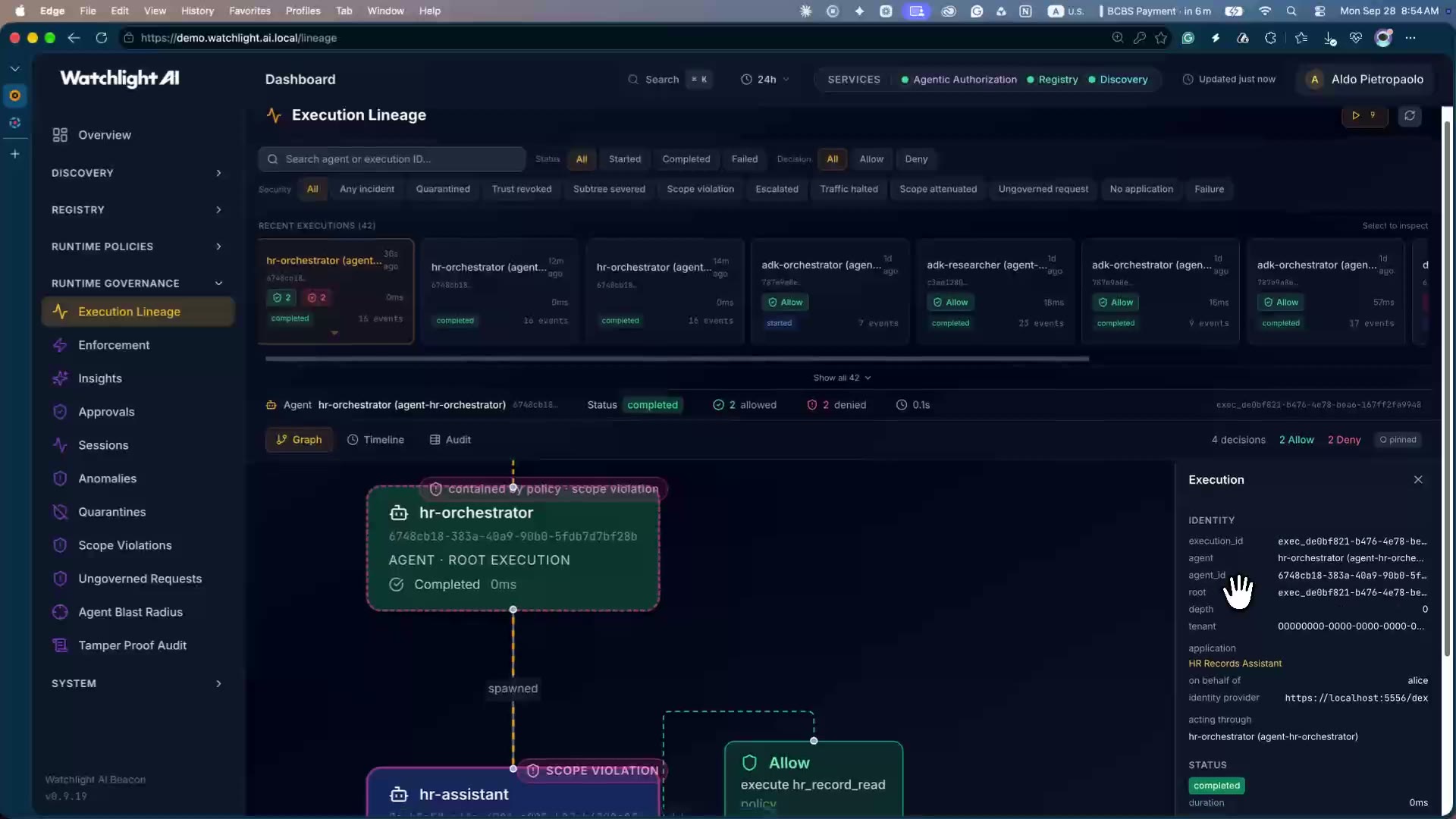
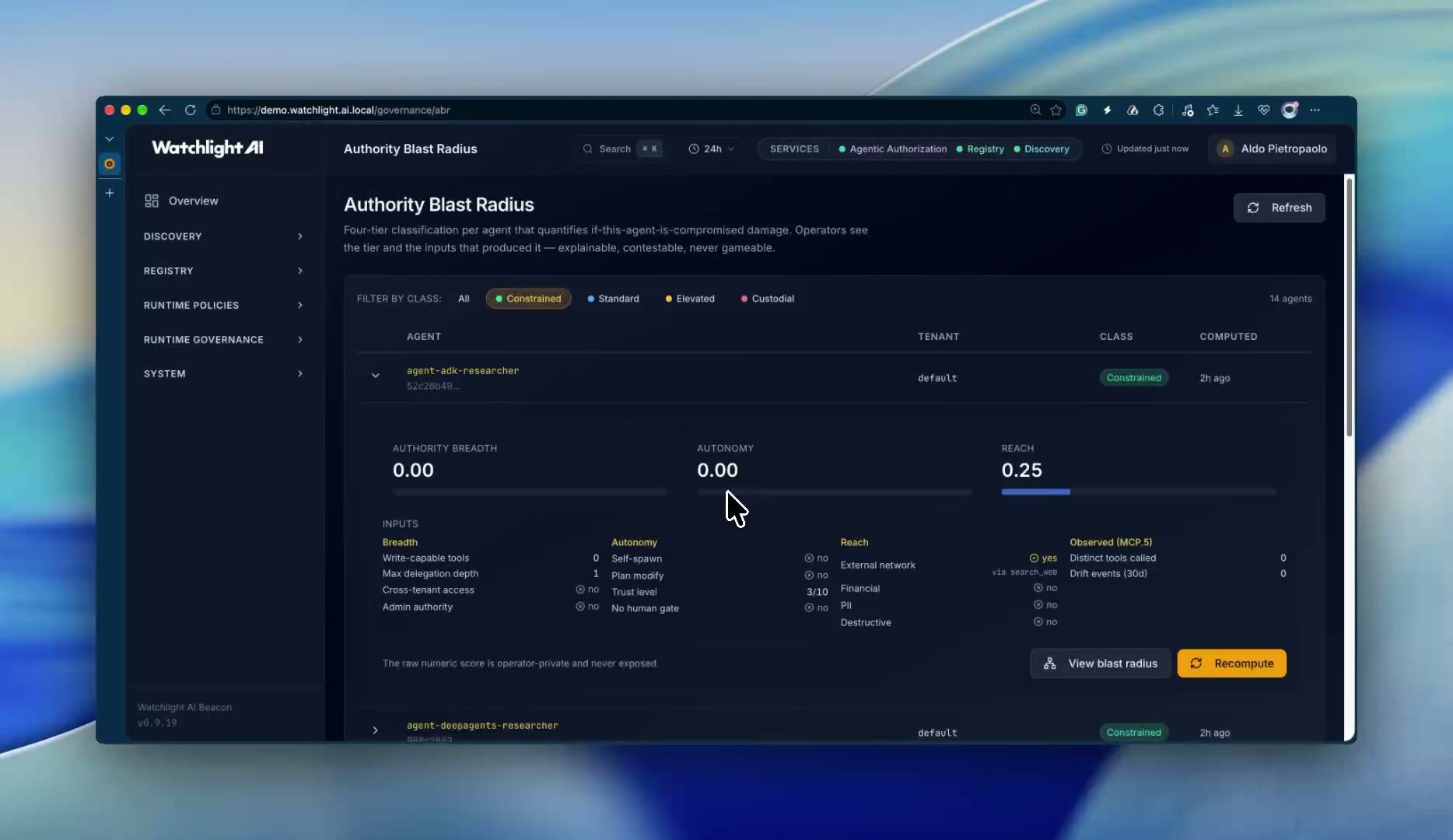
    Each agent gets a manifest of what it may do and on whose authority. When an agent declares its plan, Beacon checks the whole plan against that manifest and policy before the run starts. Authority narrows at every handoff.

  2. 02Enforce · Radar

    Check each action as it happens.

    Runs adapt, so each governed action is decided again before it executes: against the task, delegated authority, policy, and the run so far. Denied actions don’t run where enforcement points are deployed.

  3. 03Contain · Grounding

    Ground a run that goes off course.

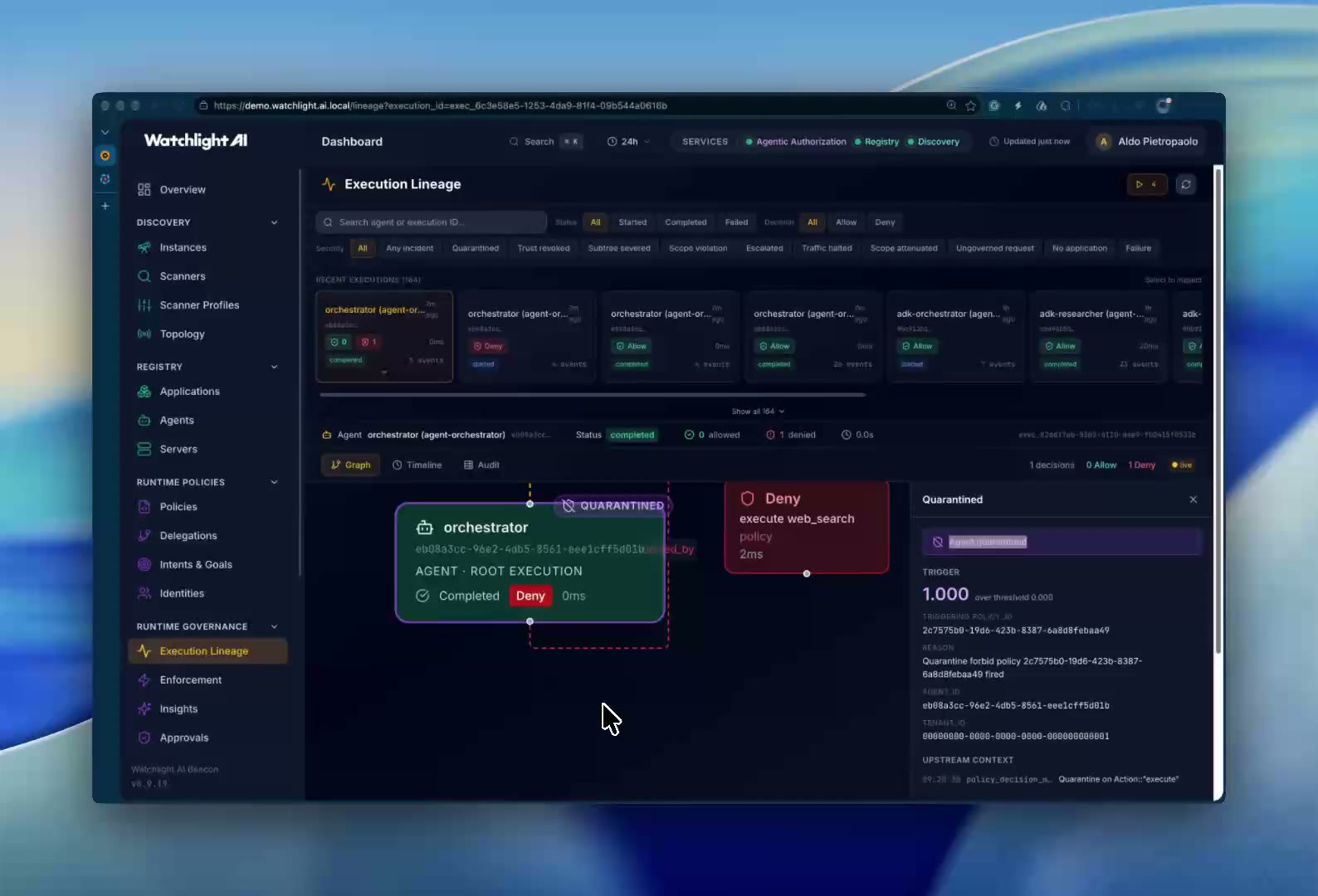
    When a run drifts from its plan or its normal behavior, Beacon can stop it, quarantine the agent, revoke its authority, or cut off the sub-agents it started, while the run is still active.

  4. 04Prove · The black box

    Keep the record.

    A signed, hash-chained record of each governed action: who authorized it, which policy decided it, the delegation chain, and the outcome. Evidence for audit and incident review.

Assess, then prove

Assess a workflow. Then prove it.

You don’t need an enterprise-wide AI agent deployment to start. Pick the path that matches where you are: still deciding which workflow comes first, or ready to test one.

Still choosing a workflow?

Agent Workflow Fit & Readiness Assessment

Bring up to three planned or active agent workflows. We map each one’s systems, permissions, delegated authority, and approvals, and tell you whether it’s ready for runtime governance now.

  • Fit now
  • Prepare for later
  • Not a fit
  • Each workflow classified: assistant, tool-using agent, or agent taking consequential actions.
  • Systems, tools, permissions, approvals, and potential enforcement points mapped.
  • A pilot charter if one qualifies, or the conditions that would make one worth evaluating later.

Up to 3 workflows · 2–3 days · Scoped up front

Ready to test a workflow?

Production-readiness pilot

Bring one workflow you’re running or preparing to deploy. With your AI platform and security teams, we integrate Watchlight AI Beacon and test its authority boundaries, runtime enforcement, and evidence before broader rollout.

  • Define permitted, prohibited, and approval-required actions.
  • Establish and test delegated authority limits.
  • Validate runtime authorization and enforcement.
  • Test applicable containment and revocation behavior.
  • Produce execution evidence and document remaining governance gaps.
  • Establish a repeatable pattern for additional agent workflows.

The pilot, in three steps

From agent workflow to governed execution.

Each step tests the moments where agent access stops being enough, on your own workflow, before it reaches more of the business.

  1. Step 1: Define the authority boundary

    Pick one workflow. Write down what its agents may do and for whom: the tools, the delegated permissions, the actions that are off limits, and the ones that need approval.

  2. Step 2: Integrate and test enforcement

    Deploy Beacon at the workflow’s enforcement points. Show that actions outside the boundary are denied before they run, including steps that only cross the line as the run adds up.

  3. Step 3: Validate and prepare for rollout

    Send a run off course and test containment. Check that the record shows who authorized each action and why. Document coverage and any remaining risks.

Where do we start?

Let’s secure your AI together.

Start with advisory, validate one workflow in a production-readiness pilot, then plan enterprise deployment with us. Start wherever you are.

  • 01 StartNot ready for a pilot yet?Start with advisoryPick the workflow to prove first in a 2 to 3 day assessment, or design agent identity and delegated authority with your IAM team.Assess Our Workflows
  • 02 ValidateFor AI platform and security leadersGet an agent production-readyValidate one workflow you’re building or preparing to deploy: its authority boundaries, runtime enforcement, and evidence.Scope a Production‑Readiness Pilot
  • 03 DeployFor enterprise security and platform teamsPlan enterprise deploymentSee Beacon enforce live, then plan how it runs across your agent workflows, in your environment.Discuss Enterprise Deployment

Still shaping your AI program? Request an advisory workshop

Questions security teams ask

What is Agent Runtime Governance?

Agent Runtime Governance (ARG) is the discipline of controlling what autonomous AI agents do while they run. It decides each governed action against policy before it executes, keeps authority scoped to the task, contains an agent that goes off course, and records what was decided. Watchlight AI defined the category in February 2026.

Read the full definition

How do you authorize AI agents in an enterprise?

Authorize each action at the moment it runs. Scope authority to the task, evaluate the action against deterministic policy outside the agent, and refuse what falls outside the scope. A valid token shows the agent can reach a system. It does not show this action should happen.

See how authorization works

How do you stop an AI agent while it is running?

You need responses beyond allow and deny, written into policy ahead of time. Stop the run, quarantine the agent until an operator releases it, cut off the sub-agents it started, or revoke its trust. Each reaches a different scope, so you can act without taking down a whole workflow.

See containment

What is an AI agent control plane?

An agent control plane is the layer that sits outside your agents and governs them across frameworks: identity, policy, enforcement, containment, and evidence. Watchlight AI Beacon is the control plane for Agent Runtime Governance.

Explore Watchlight AI Beacon
All answers

We value your privacy

We use cookies for analytics and to remember your preferences. Learn more ·