
Watchlight AI

Agent Runtime Governance

Govern the authority behind every AI agent action.

Watchlight AI Beacon determines whether an agent has the delegated authority to act, enforces that authority throughout execution, and preserves the causal lineage of what follows.

The enterprise runtime control plane for AI agents. Deterministic. On-prem. Air-gapped.

Beyond a tool-call check

Don’t just govern what agents do. Govern the authority that lets them do it.

The market is converging on runtime authorization. That is validation. The difference is depth: governing the authority behind every action, and acting on it in real time.

Now table stakes

Shipping across the market
  • Tool-call interception, per-call allow / deny
  • Agent identity and tokens
  • Request logging

Necessary, and commoditizing.

Where Watchlight goes deeper

Authority, end to end
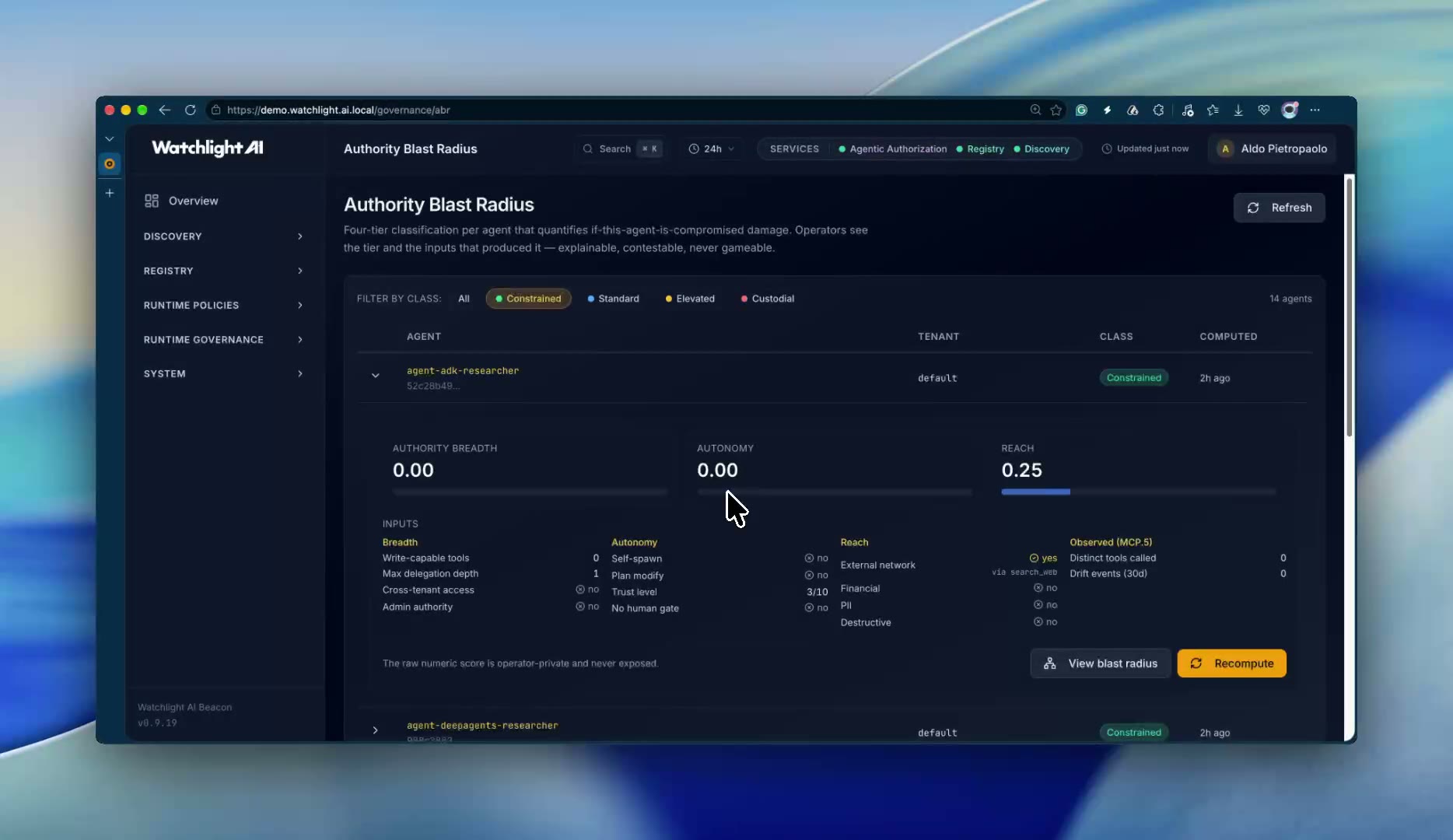
  • Delegated authority with strict-subset attenuation
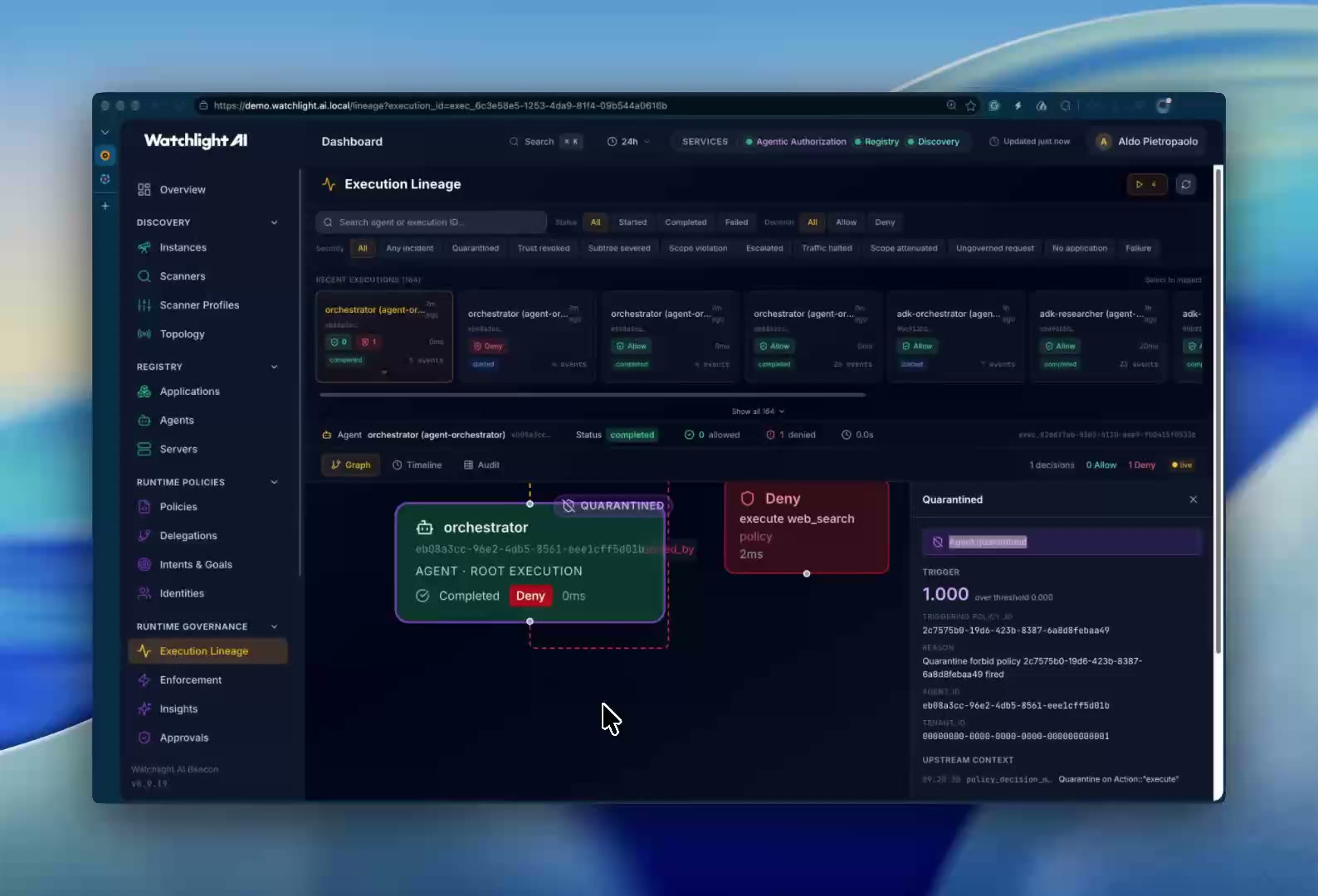
  • Real-time effects: stop the run, quarantine, sever a subtree, revoke
  • Drift and anomaly detection that quarantines, not just alerts
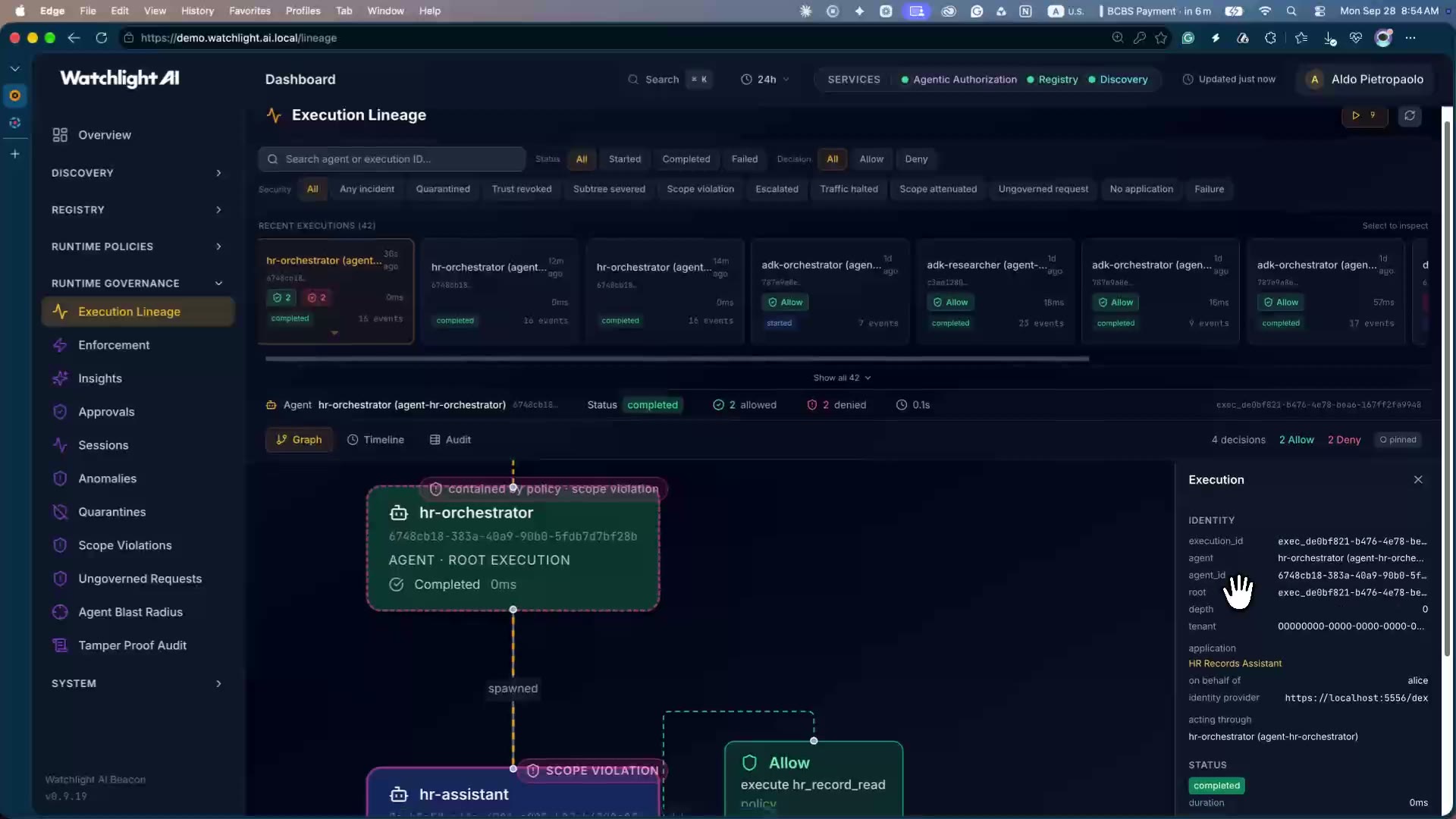
  • Signed, tamper-evident execution lineage
  • Two enforcement layers: in-process and on the wire
  • Deterministic, and sovereign to air-gapped

Real-time enforcement effects

A gateway decides one call. Watchlight contains the whole run.

Stop a run, quarantine an agent, cut off downstream sub-agents, and revoke authority, fleet-wide, when a chain goes wrong mid-execution.

Drift and anomaly detection that acts

Detection observes. Watchlight contains.

When an agent drifts from its declared plan, it is quarantined at machine speed, not queued as an alert for a human to triage later.

Delegated authority and attenuation

They authorize a request. We govern whose authority it is.

A sub-agent receives a strict subset of its parent, and any attempt to widen is denied before the action runs.

Where Watchlight sits

Every security layer answers a different question.

Watchlight governs the one that matters at the moment an AI agent is about to act.

Identity
At login

Who is the agent?

Establishes who or what is requesting access.

Model security & guardrails
At the prompt and model layer

Is the AI safe?

Protects prompts, models, content, and responses.

Watchlight AI Beacon
Before the action executes

Should this action be allowed?

Evaluates authority, task context, and policy, then enforces the decision.

Enterprise action executes only if Watchlight allows it.

Detection
After the fact

What did the agent do?

Detection and observability show what already happened.

Every layer has a job. Watchlight governs runtime authority.

Why Agent Runtime Governance is the missing layer
The shift

What changes when AI agents can act

Traditional access control assumes humans and applications operate within relatively stable boundaries. Autonomous agents create dynamic authority chains, machine-speed actions, and workflows that did not exist when those controls were designed.

  1. Agents appear before anyone registers them

    Teams stand up agents and MCP servers faster than anyone can track them. An agent no one has inventoried cannot be governed, and its authority cannot be scoped or audited.

    registered agentregistered agentunregistered agentunregistered MCP serverno owner, no policy, no record
  2. Authority can be delegated

    An agent may invoke another agent or a tool that runs with different privileges. With each handoff, authority can quietly widen, and the chain that granted it becomes impossible to reconstruct after the fact.

    HumanAgent AAgent BToolprivileges widen at each hop
  3. Individual actions can form dangerous workflows

    Each action can be individually permitted while the combined execution path exceeds what was ever intended. An agent reads the customer database, then posts to a public channel. The damage is the sequence, and per-action checks miss it.

    allow+allow+allowdangerous outcome
  4. Agents operate at machine speed

    Agents act autonomously, hundreds of steps at a time, far faster than a human can review. Detecting a problem after execution is often too late to prevent it. The decision has to happen before the action runs.

    action 1234detection arrives here
  5. Context changes authority

    The same agent may be permitted to perform an action for one task and prohibited from performing it for another. Authorization has to account for the intent the agent declared, not just the credential it holds.

    same agent · same tooltask Aallowed
    same agent · same tooltask Bdenied
  6. Enterprises need proof

    When something goes wrong, ordinary logs show that a tool was called, not who initiated it, how authority flowed, which policy was evaluated, or what was ultimately decided. Regulators increasingly expect that record on demand.

    HumanAgentSub-agentToolResourcecomplete lineage

These are the gaps Agent Runtime Governance was defined to close, and the ones Watchlight AI Beacon enforces at runtime.

See Beacon deny an action before it executes.

Watchlight AI Beacon evaluates agent authority in real time and enforces the decision before enterprise resources are affected.

A support agent's next action, export_customers to an external email address, is denied by Watchlight AI Beacon before it executes. The action is halted, not flagged after the fact.
Why Watchlight

What Beacon does at runtime

Every action is checked against formal, versioned policy at the moment of execution, across every hop of the chain, in your environment. No language model sits in the trust path.

Deterministic pre-action authorization

Every action is checked against formal, versioned policy before it runs. No language model sits in the trust path.

Runtime enforcement, before and during

Decisions are enforced at the moment of execution, across the whole workflow, not logged after the fact.

Task-scoped, intent-aware authority

Authority is granted for the intent the agent declared and the task in front of it, and nothing more.

Delegation-chain governance

Scoped, time-bound authority is validated across every hop, agent to agent to tool, not simply trusted.

Signed execution lineage

A tamper-evident record of who authorized each action, and why, as audit-grade evidence.

Framework-independent deployment

Runs across agent frameworks, on-premises to air-gapped, evaluated locally in your environment.

IAM & security depth
23+ years of enterprise identity and security architecture, applied to autonomous agents
Published framework
We authored the 12 Non-Negotiable Principles for Agent Runtime Governance
Read the 12 Principles
Defining the discipline
60+ published articles on Agent Runtime Governance, each backed by working code
Read the blog
Available now
Watchlight AI Beacon, version 0.9.13, is available now, ready to install in your environment, on-premises or air-gapped.
Designed against enterprise standards
ISO/IEC 42001ISO 27001SOC 2EU AI ActOWASP Agentic Top 10CIS Controls v8
Explore Watchlight AI Beacon
In the execution path

Watchlight sits between the agent and the resource

When authority is delegated across agents, Watchlight AI Beacon validates the delegated authority at the checkpoint. It does not simply trust the last agent’s credentials.

Human / application

initiates the work

Agent A

delegates to Agent B

Agent B

proposes an action

Watchlight AI Beacon

validates policy · authority · task context

AllowRequire approvalDeny

Tool / API / agent

the delegated call

Enterprise resource

data, infrastructure, systems

The Pattern

The Runtime Control Plane for AI Agents Is Inevitable

Every enterprise platform eventually needed a control plane. Each era of computing produced the layer that governed it. AI agents are no different, and it is happening now.

Employees
Control planeOkta
Devices
Control planeCrowdStrike
Cloud
Control planeWiz / Prisma
Kubernetes
Control planeKubernetes Control Plane
AI Agents
Control planeWatchlight AI BeaconThe next one

The pattern is the point: every platform shift creates a new layer that must be governed. Agents are that shift, and they need their control plane.

Okta, CrowdStrike, Wiz, Prisma, and Kubernetes are trademarks of their respective owners, used for identification only.

Deployment

Built for where enterprise agents actually run.

The authorization path should never become another cloud dependency. Watchlight AI Beacon makes its decisions in your environment, so the control plane stays under your control.

Deterministic. On-prem. Air-gapped.

Customer-controlled environments

Beacon runs inside your infrastructure, on-premises or in your private cloud. Enforcement is evaluated locally.

Air-gapped and regulated

Operates with no outbound connectivity, suited to air-gapped and regulated infrastructure.

Kubernetes and heterogeneous stacks

Deploys into Kubernetes and across cloud and private infrastructure, wherever your agents run.

Framework-independent

Governs agents across heterogeneous frameworks rather than locking you to one runtime.

Works with your identity provider

Downstream of your identity provider

Your IdP decides who your agents are and what token they carry. Watchlight decides whether each action is allowed, and proves what happened.

Okta · Ping · any IdP

Identity says who

Registers the agent and issues an attenuated token, scoped to the task.

Watchlight AI Beacon

Watchlight says whether

Enforces the delegated authority before execution, and proves the chain in signed lineage.

Verdict propagation back to your IdP via Shared Signals and CAEP is on the roadmap.See how Watchlight fits your identity provider
Governs the agents you already run

Native plugins for major agent frameworks, plus a framework-agnostic proxy for everything else.

  • LangGraph
  • Claude Agent SDK
  • Claude CodeNew
  • Google ADK
  • AWS Bedrock Agents
  • Microsoft Agent Framework
  • Pydantic AI
  • DeepAgents
  • OpenClaw
  • + framework-agnostic proxy
See all integrations

Framework names are trademarks of their respective owners, used for identification only.

Before you give AI agents authority, govern how they use it.

See how Watchlight AI Beacon decides what an agent may do, enforces that decision before the action runs, and proves what happened.

Need help designing it first? Explore advisory & architecture engagements

We value your privacy

We use cookies to enhance your browsing experience, analyze site traffic, and personalize content. You can choose to accept all cookies or customize your preferences. Learn more