
Agent-Native Constraints: Why AI Agents Need a Guidance Layer
Most enterprise security architectures treat AI agents like any other system component: define policies, enforce them at runtime, and log violations. When an agent attempts something it shouldn't, the system denies the request. Simple enough.
But AI agents aren't like traditional system components. They reason, plan, and adapt. They decompose complex goals into sequences of actions. They make decisions autonomously, often without human oversight at each step.
And here's the problem: when your security model only tells an agent "no" after it tries something forbidden, you've created an adversarial relationship between the agent and your Agent Runtime Governance infrastructure. The agent discovers its boundaries through failures, wastes cycles on blocked actions, and develops workarounds that may technically satisfy policy while violating intent.
There's a better approach. What if agents understood their operational boundaries before they started working—not as hard limits they'll hit, but as context they can reason about?
The Enforcement-Only Trap
Traditional security enforcement follows a simple pattern: an entity requests access to a resource, a policy engine evaluates the request, and the engine returns allow or deny. This works well for deterministic systems where access patterns are predictable and requests are independent.
AI agents don't work this way.
Consider an autonomous research agent tasked with analyzing market trends. In a single session, it might query multiple databases, execute analysis tools, generate reports, and potentially spawn sub-agents for specialized tasks. Each action builds on previous results. The agent plans several steps ahead.
In an enforcement-only model, this agent operates blind. It knows what it wants to accomplish, but it doesn't know which of its planned actions will succeed and which will be blocked. It might spend significant compute resources preparing a database query, only to discover it doesn't have access to that database. It might plan an entire analysis workflow, only to find that a critical tool in the middle of the chain is forbidden.
This creates several problems:
Wasted resources. Every blocked action represents wasted computation—not just for the denied request, but for all the planning and preparation that preceded it.
Unpredictable behavior. When agents discover constraints through failures, they adapt in unpredictable ways. They might try alternative approaches that technically work around the policy but violate its intent. They might retry failed actions with different parameters, hoping for a different result. They might give up on legitimate goals because they can't distinguish between "this specific approach is blocked" and "this entire objective is forbidden."
Poor user experience. Users delegating tasks to agents expect smooth execution. When an agent repeatedly hits walls it didn't anticipate, sessions take longer, produce worse results, and erode trust in the agent's capabilities.
Limited observability. Security teams see a stream of denied requests without understanding why the agent made those requests in the first place. Was it malicious? Misconfigured? Legitimately confused about its boundaries? Enforcement logs don't tell the full story.
What Agents Can Reason About
Here's something important to understand about modern AI agents: they're remarkably good at working within defined boundaries when those boundaries are clearly communicated.
Agents can reason effectively about structured constraints:
- Explicit permissions: "You can read documents and query databases, but you cannot modify or delete records."
- Scope boundaries: "Your access is limited to resources in the research department."
- Conditional rules: "Financial operations require approval. High-risk actions trigger escalation."
- Quantitative limits: "You have 100 actions remaining in this session."
- Intent requirements: "Database queries must be associated with a declared research purpose."
When agents understand these constraints upfront, they incorporate them into their planning. They don't waste resources on forbidden actions. They structure their approach to stay within boundaries. They know when to request escalation versus when to proceed independently.
But agents struggle with implicit constraints—the "be reasonable" rules that humans navigate intuitively. They struggle when they have to discover limits through trial and error. They struggle when they don't know whether a blocked action means "never allowed" or "not allowed right now" or "allowed with approval."
The challenge isn't that agents can't follow rules. It's that enforcement-only models communicate rules in the worst possible way: through denial after the fact.
The Guidance Layer
A guidance layer sits above enforcement and gives agents proactive awareness of their constraints. Instead of only asking "can I do this?" and waiting for yes or no, agents start each session understanding "here's everything I can do, here's what's off-limits, and here's what needs approval."
Think of it as the difference between navigating a city with turn-by-turn directions that tell you "wrong way" after you've made a turn, versus having a map that shows you all the available routes before you start driving.
The guidance layer doesn't replace enforcement. Enforcement remains the final authority—the policy engine still evaluates every action and makes the ultimate allow/deny decision. But guidance transforms how agents interact with that enforcement infrastructure.
Agents can self-govern against known constraints. When an agent knows upfront that delete operations are forbidden for its role, it doesn't waste cycles attempting deletions. It factors that constraint into its planning from the start.
Agents can pre-check uncertain actions. When an agent isn't sure whether an action will be allowed, it can ask "would this be permitted?" without actually attempting the action. If the answer is no, the agent learns why and receives suggestions for alternatives.
Agents understand why actions are blocked. Instead of a bare "denied" response, agents receive explanations: "Delete action is not permitted for researcher agents. Submit an escalation request if you need delete access." This context enables intelligent adaptation.
Agents know how to escalate appropriately. When an action requires approval, agents know who approves it, how long approval typically takes, and what happens if approval times out. They can communicate this to users and plan accordingly.
Strengthening Enforcement Through Guidance
Here's the counterintuitive insight: adding a guidance layer makes your enforcement layer more effective, not less.
At first glance, you might worry that telling agents about constraints gives them information they could exploit. If an agent knows exactly where the boundaries are, couldn't it operate right at the edge—technically compliant but pushing limits?
In practice, the opposite happens.
Reduced false positives in anomaly detection. When agents understand their boundaries, their behavior becomes more predictable. They don't probe forbidden actions. They don't retry blocked requests with variations. This means your behavioral monitoring can focus on genuinely anomalous activity rather than noise from agents discovering constraints.
Better intent signal. An agent that knows an action is forbidden but attempts it anyway is sending a much stronger signal than an agent that tries something and discovers it's blocked. Guidance-aware systems can distinguish between confusion and malice.
More meaningful audit trails. When agents receive constraint information upfront, you can log not just what they attempted but what they knew when they attempted it. An agent that violates a constraint it was explicitly told about is different from one operating with incomplete information.
Reduced attack surface from error handling. Enforcement-only models often leak information through error messages and denial responses. Attackers probe systems to map what's allowed and what isn't. A guidance layer can provide constraint information through controlled channels rather than through the side effects of blocked requests.
Cleaner separation of concerns. Guidance handles "what should this agent do?" while enforcement handles "what must we prevent?" This separation lets you optimize each layer independently. You can make guidance rich and helpful without compromising enforcement strictness.
Three Layers of Agent Governance
Effective agent governance requires three complementary layers working together:
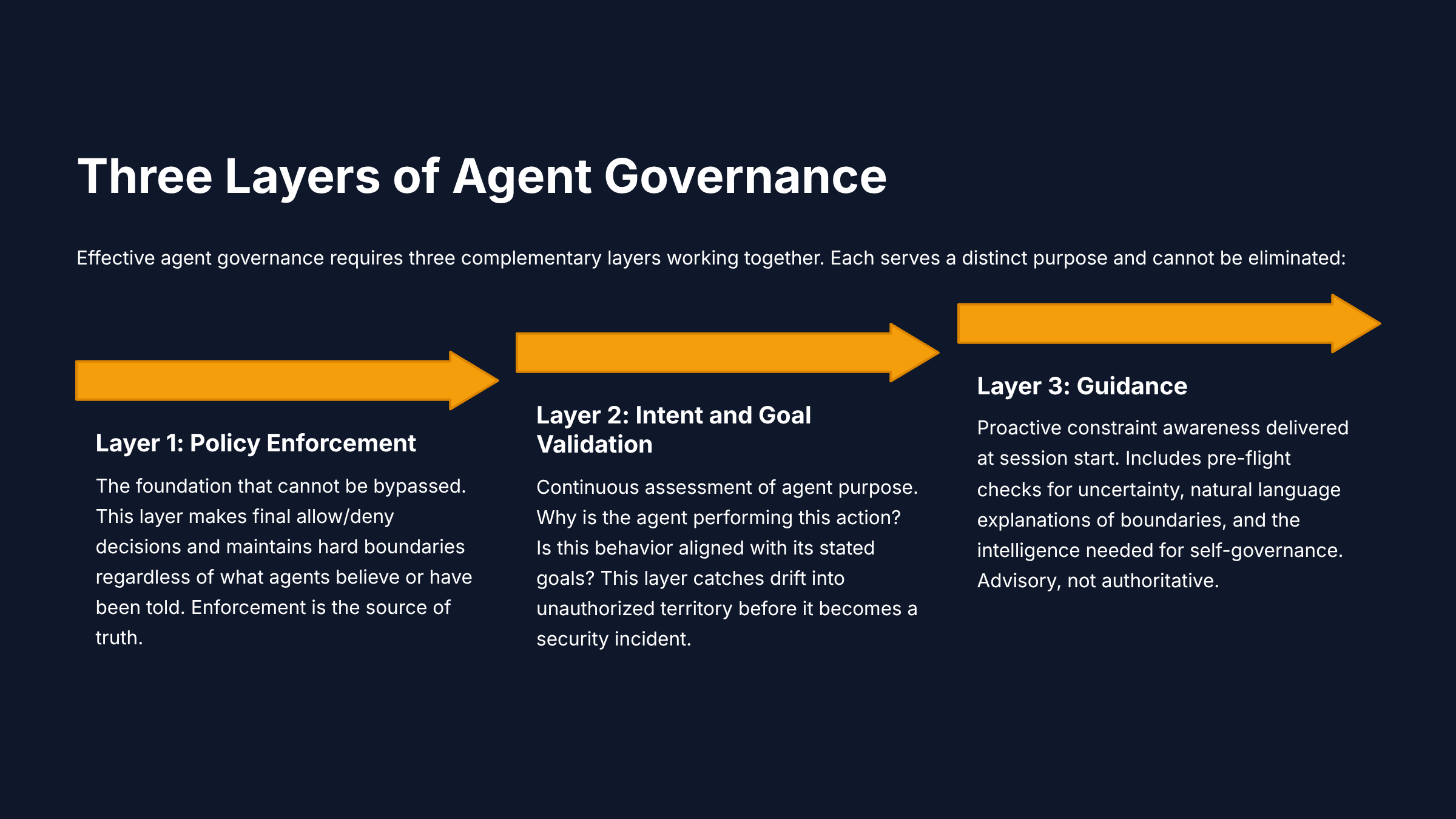
Layer 1: Policy Enforcement. This is the layer that cannot be bypassed. External policy evaluation, final allow/deny decisions, hard boundaries that constrain what agents can actually do regardless of what they think they're allowed to do. Every action passes through enforcement. No exceptions.
Layer 2: Intent and Goal Validation. Why is the agent performing this action? What is the session's declared objective? Is this specific action aligned with the stated purpose? Intent validation catches drift—agents that start with a legitimate goal but gradually expand into unauthorized territory.
Layer 3: Guidance. Constraint awareness at session start. Pre-flight checks for uncertainty. Natural language explanations of boundaries. Suggestions for alternatives when actions are blocked. This layer enables agents to self-govern against cached constraints, reducing friction while maintaining security.
The layers are additive. Guidance makes enforcement smoother. Intent validation makes both more meaningful. Together, they create a governance architecture that works with AI agents rather than against them.
Trust Before Guidance
Here's a critical point that distinguishes a well-architected guidance layer from a poor one: not every agent that asks for constraint information should receive it.
Guidance is valuable precisely because it gives agents operational context. But that same context—knowing what's allowed, what's forbidden, what requires approval—could help a malicious or compromised agent plan attacks more effectively. A guidance layer that hands out constraint manifests to any requestor is a guidance layer that helps attackers map your security boundaries.
The solution is establishing trust before providing guidance.
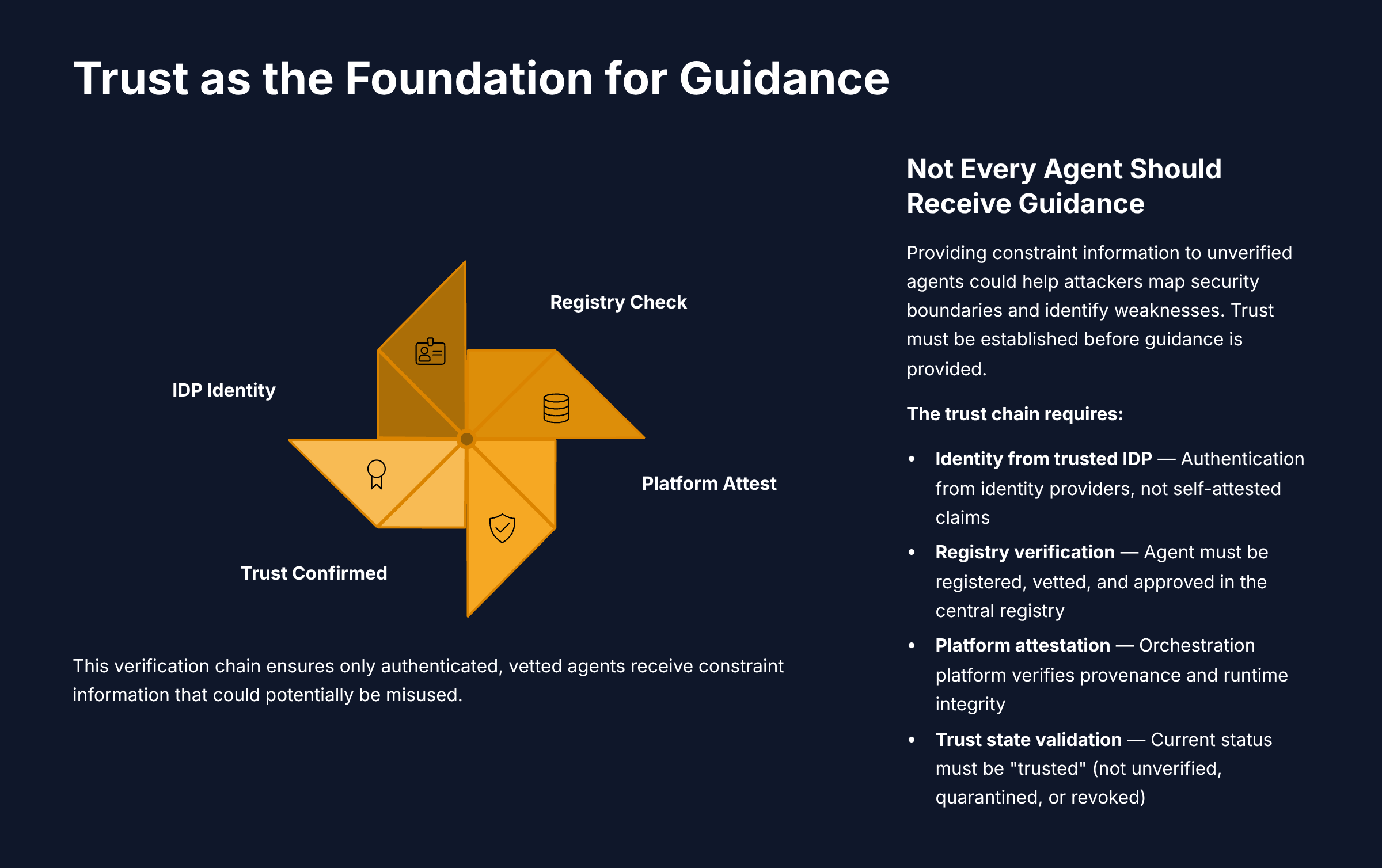 An agent must prove its identity and authorization through a chain of trust relationships before it receives any constraint information.
Identity from a trusted source. The agent's identity doesn't come from the agent itself—that would be trivially spoofable. Instead, identity flows from a trusted identity provider that the orchestration platform and governance infrastructure both recognize. The agent authenticates to the IDP, receives credentials that attest to its identity, and presents those credentials when requesting guidance. The governance layer verifies the credentials against the IDP before responding.
Registration in an agent registry. Trusted agents aren't just authenticated—they're registered. An agent registry maintains the authoritative list of agents that have been vetted, approved, and granted specific capability profiles. When an agent requests guidance, the system checks not just "is this a valid identity?" but "is this identity registered as an authorized agent with the capabilities it claims?"
Orchestration platform attestation. The agent orchestration platform—the infrastructure that spawns, manages, and monitors agents—can attest to the agent's provenance. Was this agent instantiated through approved channels? Is it running in a trusted environment? Has it been tampered with? Platform attestation adds another layer of verification that the agent requesting guidance is what it claims to be.
Trust state verification. Even registered agents have trust states that change over time. A newly registered agent might start in an unverified state with limited access until an administrator approves it. An agent exhibiting suspicious behavior might be quarantined, restricting its capabilities while investigation proceeds. The guidance layer checks current trust state before providing constraint information—a quarantined agent receives different (more restrictive) guidance than a fully trusted one.
This chain of trust—from identity provider to registry to orchestration platform to trust state—ensures that guidance flows only to agents that have earned it. An unregistered agent receives nothing. An unauthenticated request is rejected. A compromised agent whose trust has been revoked loses access to guidance along with everything else.
The guidance layer isn't a public API. It's a privileged interface available only to agents that have established trust through proper channels.
What Trusted Agents Can Do
With a proper guidance layer, agents can:
- Plan efficiently by incorporating known constraints into their approach from the start
- Fail gracefully by understanding why actions are blocked and what alternatives exist
- Escalate appropriately by knowing which actions require approval and how to request it
- Operate within limits by tracking their remaining quota and pacing their actions
- Communicate clearly by explaining to users what they can and cannot do in the current context
- Adapt intelligently by distinguishing between "not allowed ever" and "not allowed right now"
What Trusted Agents Cannot Do
Equally important, the guidance layer doesn't give agents the ability to:
- Bypass enforcement. Guidance is advisory. The policy engine makes final decisions on every action.
- Exceed their authorization. Knowing about a constraint doesn't remove the constraint. An agent that understands it can't delete records still can't delete records.
- Operate indefinitely without oversight. Guidance information expires. Long-running agents must refresh their constraint knowledge, giving administrators ongoing opportunities to adjust boundaries.
- Access information beyond their scope. Agents only receive guidance relevant to their authorization level. A low-trust agent doesn't learn about high-trust capabilities it can't use.
The Path Forward
The industry is beginning to recognize that AI agents require purpose-built governance—not retrofitted human identity models, not traditional API security, but architectures designed for autonomy, delegation, and machine-speed operation.
Enforcement remains essential. You must have a layer that cannot be bypassed, that makes final decisions, that constrains agent behavior regardless of the agent's intentions. No guidance layer changes this requirement.
But enforcement alone creates friction, wastes resources, and produces agents that operate through trial and error rather than informed planning. Adding a guidance layer transforms the relationship between agents and governance from adversarial to collaborative.
Agents that understand their boundaries reason better within them. Systems that communicate constraints clearly can monitor compliance more effectively. Organizations that implement guidance layers get both better agent performance and stronger security posture.
The goal isn't to make agents more powerful. It's to make them more predictable—and predictable agents are governable agents.
Watchlight AI helps enterprises implement Agent Runtime Governance that balances autonomy with control. If you're deploying AI agents and need governance that works with them rather than against them, let's talk.
Subscribe to Watchlight Insights
Get new writing on Agent Runtime Governance, AI agent security, agent identity, and delegated authorization, delivered when we publish. No noise, just the new posts.
Unsubscribe anytime. We never share your email.
Put runtime governance in front of every agent action
Watchlight AI Beacon is available now, fully on-premises and air-gapped. Request a demo to see it in your environment.
Agent Governance Readiness Assessment
Evaluate your governance posture against the 12 principles. Get a maturity score and roadmap.
2-3 days · Download one-pager (PDF)