
You Can't Secure What You Don't Govern: The Case for Agent Runtime Governance
Authorization and Runtime Control Architecture
Design the governance control plane your AI agents need before they reach production.
An AI agent in your customer support workflow accesses a patient record it was never supposed to see. It pulls the data, passes it to another agent for analysis, and generates a response that includes protected health information. By the time anyone notices, the data has crossed three system boundaries and been written to a log that your compliance team will eventually find during an audit.
The question security leaders ask in this moment is always the same:
"Who authorized the AI to do that?"
In most organizations today, the answer is: nobody. The agent had valid credentials. The API accepted the request. The permissions were technically sufficient. But nobody authorized this specific action, for this specific purpose, at this specific time. The agent acted within the boundaries of its static permissions but well outside the boundaries of what it should have been doing.
This is the gap that defines AI agent security today. And two fundamentally different approaches are emerging to address it.
The Emerging Response: Runtime Detection
A growing wave of solutions is focused on runtime detection for AI agents. These platforms monitor agent behavior in real time, detect anomalies or unsafe actions, and intervene by blocking or alerting when something looks wrong.
This is valuable work. Runtime detection provides visibility that most organizations lack today. It answers an important question: "What are our agents actually doing?" For security teams accustomed to operating blind, that visibility is a significant step forward.
Detection platforms typically observe process activity, API calls, data access patterns, and inter-agent communication. When an agent's behavior deviates from expected patterns, the system flags it, blocks it, or alerts an operator. Think of it as a security camera system for AI agents: it watches what happens and sounds the alarm when something looks wrong.
This capability is necessary. Any production AI agent deployment should include runtime monitoring.
But it is not sufficient.
The Core Problem
Detection happens after execution has already begun.
By the time a detection system identifies that an agent is doing something it should not, the agent has already started doing it. The API call has been initiated. The data has been accessed. The downstream agent has received the input. Detection systems are observing the consequences of an action that was never evaluated before it occurred.
This is the fundamental limitation. Detection answers "what went wrong?" It does not answer "should this have been allowed to happen in the first place?"
Consider the difference:
A detection system sees an agent access a sensitive database table and flags it as anomalous. The alert fires. The security team investigates. They discover the agent had valid credentials, the table was within its access scope, and the action matched a known agent behavior pattern. The detection system correctly identified unusual activity, but it cannot determine whether the agent was authorized to perform this specific action, for this specific task, under this specific delegation chain, at this moment in time.
The detection system has no concept of the agent's declared intent, its current authority grant, the delegation chain that led to the action, or the policy that should have governed it. It sees behavior. It does not see authority.
This is not a criticism of detection. It is an observation about what detection was designed to do. Security cameras are essential, but they do not replace access control. You need both.
The Missing Layer: Agent Runtime Governance
Agent Runtime Governance (ARG) is the control plane that determines what an agent is allowed to do before it acts. It sits between identity systems and agent execution, evaluating every action against the agent's identity, declared intent, current authority grant, delegation chain, and the policies that govern its behavior.
Where detection observes and reacts, governance defines and enforces.
The difference is architectural. An ARG control plane evaluates authority at the moment of action. Before the API call is made. Before the data is accessed. Before the downstream agent receives the request. The evaluation is deterministic: same agent, same context, same action produces the same governance decision every time.
Key capabilities of the governance layer:
- Agent identity context: verified identity tied to purpose, owner, and trust state
- Intent and task validation: the agent's declared purpose is validated against the action it is attempting
- Scoped, ephemeral authority: access is granted for a specific task, with a specific scope, for a limited time
- Delegation chain evaluation: when one agent delegates to another, the chain is validated and authority narrows at each hop
- Pre-execution policy decision: formal policy (Cedar, OPA) is evaluated before the action proceeds
- Credential brokerage: the agent never holds raw credentials; short-lived capability tokens are issued per action
The Full Picture
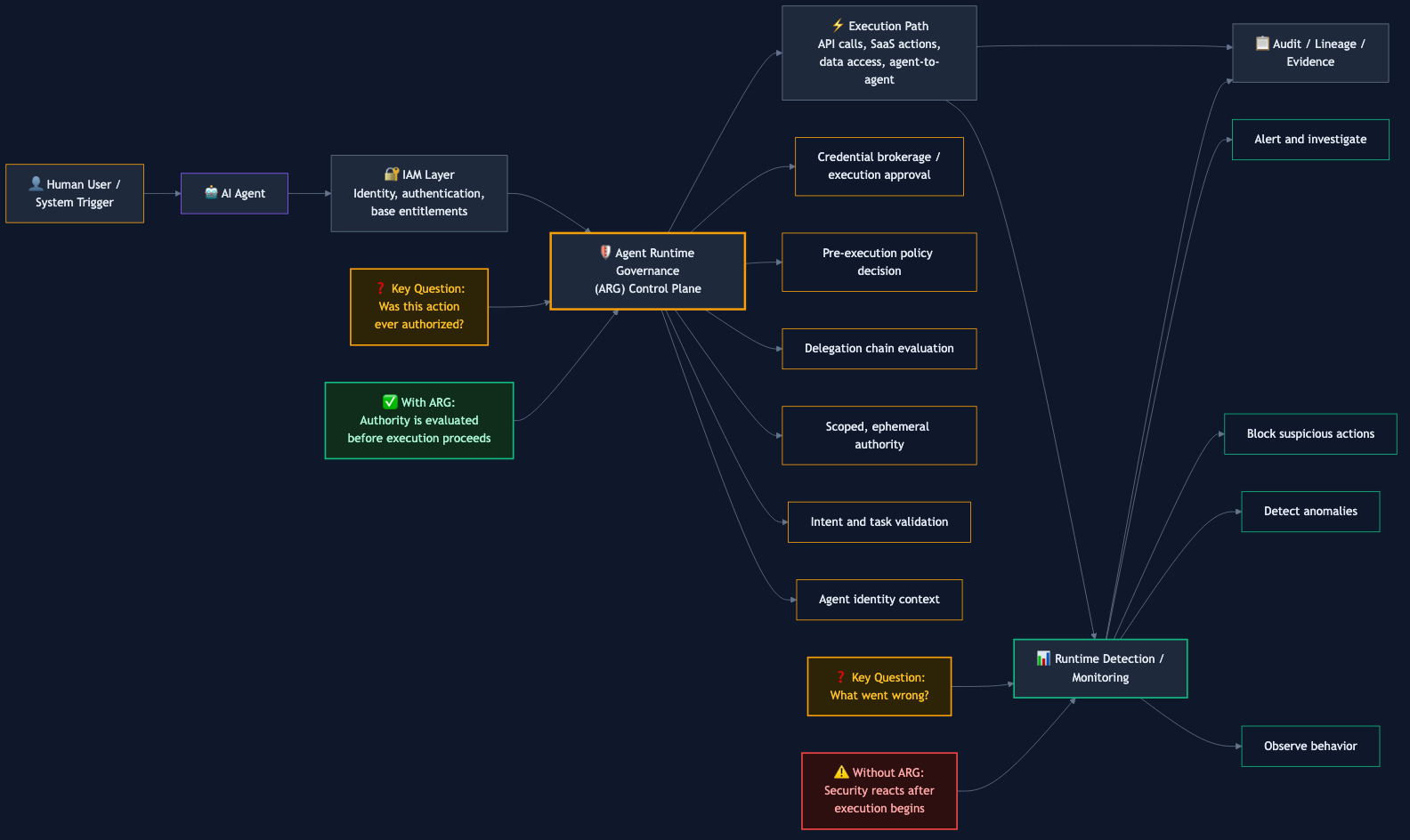
The diagram illustrates the complete security architecture for AI agents. The governance layer (ARG) evaluates authority before execution proceeds. The detection layer monitors behavior after execution begins. The audit layer captures evidence from both. All three are necessary. None can substitute for another.
Detection vs Governance: A Clear Contrast
| Runtime Detection | Agent Runtime Governance | |
|---|---|---|
| When | During and after execution | Before execution |
| What it does | Observes behavior, detects anomalies | Defines authority, enforces policy |
| Key question | "What went wrong?" | "Was this ever allowed to happen?" |
| Model | Reactive: detect and respond | Proactive: evaluate and permit (or deny) |
| Authority awareness | None: sees actions, not authorization | Full: evaluates intent, scope, delegation, policy |
| Analogy | Security cameras | Access control |
Detection tells you when an agent goes rogue. Governance ensures it never had the authority to go rogue in the first place.
Both are necessary. But without governance, detection becomes the primary control, which means the organization is reacting to events that should never have been permitted.
The Layered Model
The architecture that production AI systems require has three layers, each answering a different question:
IAM Layer: Who is this agent? Identity systems authenticate the agent, establish its verified identity, and manage base entitlements. Standards like OIDC, SPIFFE, and SCIM operate here.
ARG Layer: What is this agent allowed to do right now? The governance control plane evaluates every action against declared intent, scoped authority, delegation context, and formal policy. This is the layer that most organizations are missing.
Detection Layer: What did this agent actually do? Runtime monitoring observes behavior, detects anomalies, blocks suspicious actions, and generates alerts for investigation.
IAM without ARG produces agents with unbounded authority. ARG without detection produces agents whose actions are governed but not monitored for deviations. Detection without ARG produces alerts for actions that should never have been permitted. All three layers working together produce governed, monitored, auditable AI agent operations.
Why This Matters Now
AI agents are moving from experimentation to production across every industry. They interact with APIs, SaaS platforms, databases, and other agents at machine speed. They choose tools at runtime. They delegate tasks to sub-agents. They accumulate context that persists across sessions.
Static IAM permissions assigned at deployment are not sufficient to govern this behavior. Periodic access reviews are not sufficient. And post-execution detection, while valuable, is not sufficient on its own.
Enterprises need deterministic control over agent actions at the moment of execution. They need to know that every action was evaluated against current policy, under a valid authority grant, with a verified delegation chain, before the action was permitted to proceed.
This is not a future requirement. Organizations deploying AI agents into production environments today are facing this gap. The agents are running. The governance infrastructure must catch up.
Governance Is the Foundation
You cannot secure AI agents by watching them. You secure them by governing them.
Runtime detection is an essential layer in the AI security stack. It provides the visibility and response capability that every production system needs. But detection alone cannot answer the question that CISOs, compliance teams, and regulators will ask: "Was this action authorized?"
Agent Runtime Governance provides the answer. It is the control plane that defines, evaluates, and enforces what AI agents are allowed to do before they do it. It is the layer that makes detection meaningful, makes audit defensible, and makes production AI agent deployments trustworthy.
The organizations that build this governance infrastructure now will be the ones that can adopt AI agents at scale with confidence. The agents are already running. The question is whether the governance layer is ready.
Agent Runtime Governance is the architectural layer between identity systems and agent execution environments. Watchlight AI Beacon is the enterprise control plane that implements this layer. To learn more, read the 12 Non-Negotiable Principles or explore our advisory workshops.
Need to design the governance control plane for your AI agents? Our Agent Authorization & Runtime Control Architecture engagement helps enterprise teams design agent identity, scoped authority, and runtime policy enforcement. Download the one-pager (PDF) or discuss an engagement.
Subscribe to Watchlight Insights
Get new writing on Agent Runtime Governance, AI agent security, agent identity, and delegated authorization, delivered when we publish. No noise, just the new posts.
Unsubscribe anytime. We never share your email.
Put runtime governance in front of every agent action
Watchlight AI Beacon is available now, fully on-premises and air-gapped. Request a demo to see it in your environment.
Agent Governance Readiness Assessment
Evaluate your governance posture against the 12 principles. Get a maturity score and roadmap.
2-3 days · Download one-pager (PDF)